One mother. Three children. One bag of rice and a reminder that compassion still reaches the hardest places.
The road to Nawanyaggo is a red dirt road.
In the dry season, it carries dust. In the rain, it softens beneath each step, making the journey slow and heavy. It is not a road many people travel by accident. It is the kind of road that asks something of those who walk it.
But these are the roads we have learned to follow.
Because at the end of roads like this are families whose needs may never reach the world’s attention, yet whose suffering is no less real. They are not statistics. They are mothers, fathers, grandparents, and children doing their best to survive with very little.
They are also seen by God. Scripture reminds us in Proverbs 31 to speak up for those who cannot speak for themselves. For many families living in rural poverty, their needs may never make headlines. But they still matter. Their children still face hunger. Their prayers still rise. Their lives still carry dignity.
At the end of this road was the small mud-brick home of Namulondo Hajira, a 35-year-old widow raising three children on her own: Naome, age 3; Joseph, age 6; and Fauzia, age 12.
It was raining when our team arrived. They found Hajira standing in the doorway of the only shelter her family had. Behind her was a home with very little inside. No furniture. Barely enough food to carry her children through another day.
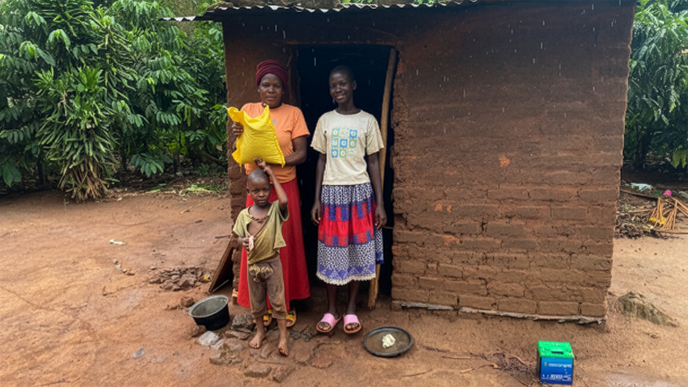
It is difficult to imagine going without food for days at a time. It is even harder to imagine looking at your children or grandchildren and not knowing what you can give them. For Hajira, that fear was not imaginary. Hunger was the question waiting in her home every morning:
What will my children eat today? No parent should have to carry that question.
A lack of food is never only about an empty stomach. For young children, poor nutrition can affect growth, strength, learning, and the body’s ability to fight illness. In Uganda, more than one third of young children, about 2.4 million are stunted, and half of children under five are anemic. According to UNICEF, children’s growth before age five is shaped more by nutrition, feeding practices, environment, and health care than by genetics or ethnicity.1
For mothers like Hajira, these are not distant statistics. They are the real concerns that come when food is uncertain.
Across sub-Saharan Africa, children remain especially vulnerable. In 2024, 4.9 million children died before reaching their fifth birthday worldwide. WHO reports that sub-Saharan Africa accounted for 2.8 million of those deaths, or 58% of all under-five deaths that year. ²
Those numbers are painful, but they help explain why food assistance matters so deeply when a child is hungry.
How much is left?
How long can it last?
Which child needs it most today?
How quietly can a mother go without it?
In many rural communities, this burden is carried out every day. Mothers stretch what little they have, giving what they can and often keeping less for themselves.
That day, help came down the red dirt road. Because someone like you made a $25 donation, we were able to bring Hajira’s family a bag of rice. A bag of rice may seem simple. It does not sound grand, makes much noise, or comes with a ceremony. But a hungry family understands the value of simple things.
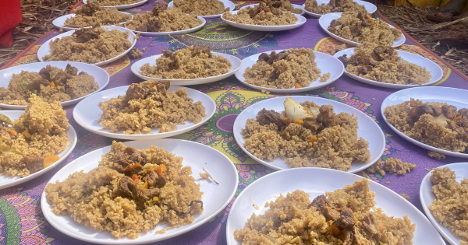
Rice is also a familiar and practical food in Uganda. Common staple foods across the country include bananas, cassava, beans, sweet potatoes, rice, millet, and sorghum. In many homes, these foods are more than ingredients.
They are part of daily meals, family care, and survival. So, when our team brought Hajira’s family a bag of rice, it was not simply a donation.
It was food her family could use, relief she could feel, and one less evening spent wondering how she would feed her children. It meant three children could eat, rest, and wake up to a little less uncertainty.
Most of all, it meant someone had traveled that road and remembered her family was there.
Food assistance does more than quiet hunger for a day. It helps protect children’s health, supports growth and development, and eases the fear that settles over a home when there is not enough to eat. It gives families strength for today while longer-term care continues through education, safe drinking water, medicine, housing, and mission support.
Before we left, we also shared the Gospel with Hajira and prayed together. It was a quiet moment, but a meaningful one. The love of God was not only spoken that afternoon. It was carried through a bag of rice, through a prayer, through a moment of being seen, and through the simple act of showing up where help was needed.
During 2025, thanks to the compassion of our donors, we provided more than 1.7 million meals to children and families in urgent need.
These meals included locally purchased foods such as rice, beans, meat products, gari, cornmeal, and powdered milk. When possible, buying food locally allows us to respond to immediate needs with familiar foods while working within the communities we serve.
This local approach matters, especially in Uganda, where rural life, food, and agriculture are deeply connected. The World Bank has noted that Uganda’s agriculture sector plays a critical role in the economy, accounting for about 70% of employment and more than half of exports. ³
It also honors the people who help keep communities fed. In Uganda and many parts of the world, women play a vital role in growing food, preparing meals, caring for children, and helping families survive through seasons of hardship. Yet many women farmers still face barriers to land, financing, training, tools, and access to markets. The United Nations has declared 2026 the International Year of the Woman Farmer, recognizing that women farmers are central to food security, nutrition, and economic resilience. ⁴
For families like Hajira’s, this matters deeply. Food relief is not only about filling a bowl today. It is also about recognizing the mothers, caregivers, farmers, and communities who carry so much of the daily burden of survival, care, and hope.
We also supplement these local purchases with food shipped from the United States and, increasingly, with food grown or raised within our missions. Each source of food helps us meet the same purpose: reaching children and families who may otherwise go without.
This work reaches children living in our orphanages, students attending our mission schools, and families in rural villages where access to food, care, and support can be difficult.
Why One Meal Matters
A meal is never just a meal when a child is hungry.
Food helps children grow, learn, heal, and stay strong against illness. It helps parents and caregivers breathe a little easier. It gives families strength for today while longer-term support continues through education, clean water, housing, medicine, and spiritual care.
Psalm 146 tells us that the Lord gives food to the hungry and upholds the widow and the fatherless. In Hajira’s doorway, that truth felt close. Her family’s need was immediate, but so was the reminder that God had not forgotten them.
For families living in extreme poverty, one meal can be the difference between fear and relief. One bag of rice can mean a mother does not have to wonder who will eat. One visit can remind a family that they are not alone.
The number matters because it reflects what faithful giving can do. More than 1.7 million meals means children were fed, families were strengthened, and mothers like Hajira were given relief when the need was immediate.
But even a number that large cannot tell the whole story. Behind every meal is a child who needs strength to grow, a mother trying to face another day, and a family longing to know they have not been forgotten.
More Than Food Alone
Hajira’s story reminds us that need is not only measured in reports or statistics. It is measured in quiet doorways, empty bowls, and the daily uncertainty carried by families doing everything they can to survive.
As 1 John reminds us, love is not only spoken. It is shown through action and truth.
For Hajira, love looked like someone was coming through the rain.
For her children, love looked like food in the home.
For our team, love looked like prayer, presence, and the Gospel shared with compassion.
For donors, love looked like giving faithfully so help could reach a family they may never meet.
The Road Is Still There
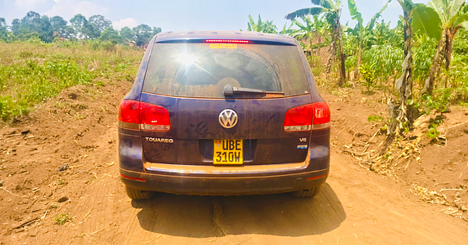
The need in rural Africa is vast, and our missionaries are only scratching the surface. Still, we believe each road is worth traveling. Each family is worth reaching. Each meal is worth giving. Because sometimes, compassion and the love of Christ look like one bag of rice at the end of a red dirt road.
Help Hope Keep Traveling
Regular giving helps us support our food distribution program and the programs that make lasting improvements in the lives of children and families facing extreme poverty.
We call our monthly donors Hope Ambassadors because their faithful giving helps provide steady care to those facing urgent needs in Africa, India, and Pakistan.
As a Hope Ambassador, your regular gift helps make sure families like Hajira’s are not only seen once but reached with ongoing compassion. It helps provide food, medicine, safe drinking water, education, housing, and practical care where it is needed most.
It helps us travel the roads others may never see.
And it helps remind children and families facing hardship that they are not forgotten.
To every donor who helps make this work possible: thank you. Your generosity feeds children, strengthens families, and brings dignity to places where the need is urgent, quiet, and deeply human.
A monthly gift of $25 or more makes you a Hope Ambassador, helping provide steady support for children and families facing urgent needs.
Help hope keep traveling. Become a Hope Ambassador today and help provide food, medicine, safe drinking water, education, housing, and practical care to children and families in Africa, India, and Pakistan.
Or call our office at 920-729-5721 to learn more.